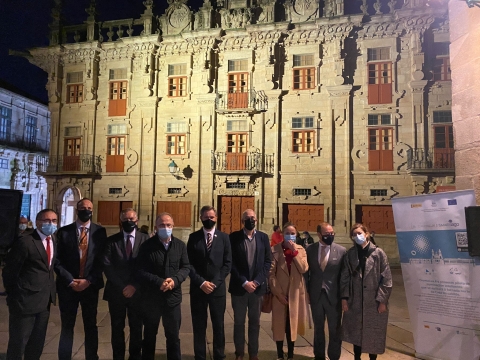
The CromaLux smart lighting project on facades and historic monuments in Santiago, which is part of the Smartiago program of the Santiago City Council, is completing three months of testing at Casa do Cabildo with initial positive results on the inhibition of biological colonization, in addition to those in the courtyard of the old prison, where another test with the same characteristics began eight months ago.

The objective of this pioneering initiative is the development and installation of smart lighting solutions on facades and historic monuments in Santiago de Compostela that help stop and control the growth of biological colonies that degrade these infrastructures, improving conservation and reducing the need for complex cleaning and restoration interventions.

“Regarding the validation of the biostatic capacity of CromaLux lighting on colonizing organisms in buildings, after 8 months of testing (June 2021-January 2022) on the walls of the courtyard of the old jail of the Local Police building and 3 months test (November 2021-January 2022) on the main facade of Casa do Cabildo, the inhibition in the growth of organisms has been quantitatively demonstrated in both locations”, explains Patricia Sanmartín, doctor from the USC and scientific director of the project, since launched jointly by Televes, Ferrovial and the USC.

“The results in the first pilot of the courtyard of the old prison are more evident, due to the greater time elapsed, and it is observed that the biostatic capacity of the lights is enhanced over time, as well as the greater initial presence of organisms. Graphing the results taken fortnightly in recent months, a positive trend is observed, which marks a growth in colonization, when applying the lighting with which the monuments of the historic center of Santiago are currently illuminated, while in the areas without night lighting and with CromaLux lighting the trend is negative, which marks a decrease, which is almost double with the new lighting solution compared to non-illuminated areas”, she explains.
Regarding the impact of CromaLux lighting on the surrounding biodiversity, taking insect communities as a study group, the test has been completed, which has been maintained during the hot months in which it is possible to carry it out (June 2021-October 2021) and which has Consisting of a total of 15 samplings with 3 sampling points each, "the results obtained confirm that the impact on both quantity (total number of insects) and diversity (variety of orders and morphospecies) can be considered null at use the new CromaLux luminaire, obtaining significantly identical results to those collected in an area without artificial lighting during the night hours”, adds Patricia Sanmartín.

"When comparing CromaLux with the current light that illuminates the monuments of the historic center, it is observed that the change of luminaire would reduce the impact of artificial light during the hours of the night in the amount of insects, and that this change would have a minor impact on the diversity of some orders, especially Trichoptera, Neuroptera and Coleoptera”, she concludes.

The CromaLux project's main objective is to preserve the condition of Santiago de Compostela as a model of heritage conservation through intelligent ornamental lighting.

For this, an efficient and environmentally responsible lighting system is being developed to control biological colonization in elements of high heritage value, taking advantage of LED technology and remote control of lighting with biostatic capacity, which is easily integrated into buildings with high heritage value. , with minimal or no architectural impact.
